
The Real Cost of Checked Bags vs Carry-On for Business Travel

You're booking another work trip, and there it is again: the checked-bag add-on, about $35 each way, on a route you've already flown twice this month.
Or you're the one still at the carousel at 11 p.m. the night before a client meeting, watching everyone else's bags come out.
Or you made it to the gate carrying on, and the gate agent weighed your bag and made you check it at the last minute.
For most short domestic trips, carrying on wins on total cost. But the fee everyone argues about is the smallest part of the bill.
Three quieter costs matter more:
- The 20 to 30 minutes you lose at the carousel.
- The small chance your bag doesn't arrive.
- The price of the bag itself spread across the years you own it.
None of them shows up on the booking page, and on a longer or heavier trip, they can flip the answer.
Carry-on or checked: which costs more?

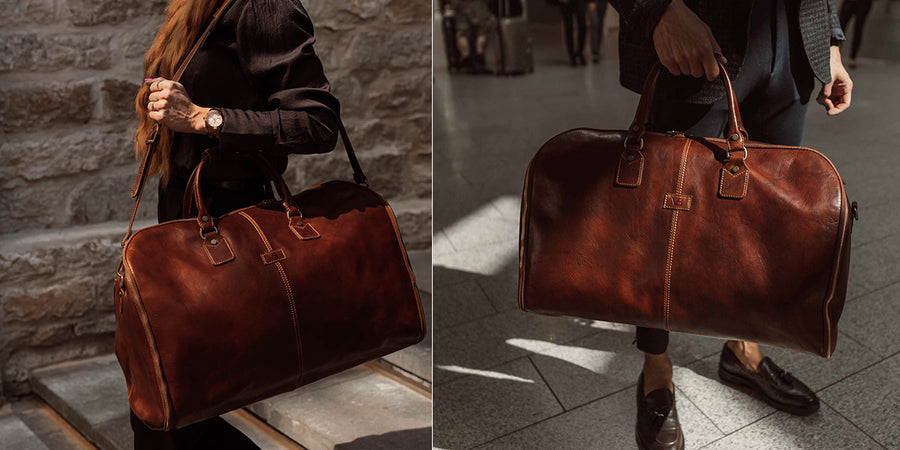
Image: Grand Leather Garment Bag
For a one to three day domestic trip with no suit and nothing you can't replace, carrying on almost always costs less overall.
- You skip the fee.
- You skip the wait.
- On a trip that short your things still fit.
All three point the same way, which is why the gap is wider than the fee alone makes it look.
The fee is also the only cost that never changes. It's $35 to $45 on a two-day trip and the same $35 to $45 on a ten-day one.
The rest all change with the trip: the time you lose at the airport, the risk of the bag going missing, and the price of the bag itself.
So once a trip gets longer, heavier or more formal, those are what you're really deciding between.
Who pays the checked bag fee on a work trip?

On most major US airlines a first checked bag costs roughly $35 to $45 each way, so about $70 to $90 round trip. On a work trip, though, that fee is often theoretical.
Hold airline elite status or carry the airline's co-branded credit card and the first checked bag is usually free. And if you do pay it, you expense it.
So you often spend nothing out of pocket, and the decision comes down to time and risk rather than dollars.
But on basic economy tickets and no-frills carriers, the overhead carry-on is a paid add-on, and it can cost as much as the checked bag (sometimes more). On those fares, carrying on is not the free option.
So read what your ticket includes before you book. The lowest fare is often the one that charges most to bring a bag on board.
How much time does checking a bag cost?
Checking a bag costs you time at both ends, and often 20 to 30 minutes of it standing at the carousel after you land.
Carry it on and you walk off the plane and straight to the taxi line or the rental desk.
You pay both when you check: $35 to $45, plus 20 to 30 minutes you don't get back. Which of the two costs you more comes down to your hourly rate.
Twenty to thirty minutes is worth more than $35 to $45 once you bill somewhere above $70 to $135 an hour, depending on which end of each range you're at.
Above that, the wait costs you more than the fee, and the wait is the one that never reaches an expense report.
And flying more often doesn't change the math. Fly twice a week and you lose those minutes twice a week, but you pay the fee twice a week too. The ratio is the same at one trip as at fifty.
The wait costs you least when you land the night before with nowhere to be, and most when you go straight from the airport into a room full of people.
And when you land with barely enough time to make the meeting, that wait is time you don't have.
Anyone who tells you to just check it is assuming your arrival time is free, and on a work trip it usually isn't.
What a lost or delayed bag costs you

A lost or delayed bag doesn't cost you the fee or the wait. It costs you the morning before a meeting, when the bag isn't there.
It doesn't happen often. US airlines mishandle roughly 6 to 7 checked bags for every 1,000 passengers, according to US Department of Transportation figures.
But the same delay costs you more on a work trip. A vacationer whose bag is a day late loses a change of clothes.
You can lose a first impression, a signed contract or the keynote you flew in to give.
And airline compensation for a delayed bag is capped, slow, and never covers the meeting you missed.
So carry on anything you can't walk in without, and check only what you could replace when you get there.
Your laptop, the presentation, the suit you're speaking in, those stay with you. The spare shoes and the toiletries can go in the checked bag.
Can a carry-on hold a full business trip?

Image: Weekender Women's Leather Weekend Bag
Yes, a carry-on holds a full business trip of one to three days. What pushes you past it is a week's worth of outfits, bulky presentation gear or a suit you can't afford to crease.
Most US airlines cap a carry-on around 22 x 14 x 9 inches (56 x 36 x 23 cm), which is enough for a short trip if you pack with any discipline.
The limit you'll forget is the liquids rule. Under TSA 3-1-1, a week of full-size toiletries either gets checked or gets bought again at your destination, and that second purchase is a real cost you're leaving out when you call the carry-on free.
A suit is the classic sticking point. You can fold one into a carry-on and steam it in the hotel bathroom, or use a dedicated garment carry-on that keeps the jacket from creasing in the first place (we compare those here).
And on a longer or mixed trip, the better call is often neither all-carry-on nor all-checked: carry the things you can't be without, and check the bulk you could replace.
The bag itself is a cost most people skip

The bag is the one cost the fee comparison always skips. And if your checked-bag fee is waived by status or goes on an expense report, it's the only one of the two you pay for yourself.
An inexpensive carry-on you replace every year or two can cost more over a decade than one good bag you buy once.
It also tends to fail at the worst time, mid-trip, when you have no way to fix it.
On a leather bag, or any well-made travel bag, the material almost never fails. The zipper is what gives out.
So a bag's life comes down to its hardware and whether it can be repaired, not to how the outside looks.
An expensive-looking bag with a weak zipper is a worse buy than a plain one built around good hardware. (Given the choice, I'd take the plain one, and I'd want one I could get repaired.)
The empty weight is part of that cost too
A heavy empty bag uses up part of the airline's weight limit before you pack a thing.
On a carrier that weighs carry-ons at the gate, a heavy empty bag can put you over the limit and end up in the cargo hold, so you pay the fee and lose the time you carried on to save.
So the bag worth buying has hardware that lasts and can be repaired, and weighs little enough on its own to stay under the carry-on weight limit where a carrier enforces one.
We build our business-travel bags to that standard (you can see them here), backed by a 5-year limited warranty and a price that stays the same.
Whatever you carry: count the empty weight and the years you'll get out of the bag before you compare either to a fee.
When checking a bag is the lower-cost choice

Checking is the lower-cost call more often than the carry-on-only crowd will admit:
- Trips of four days or more, where a week of clothes and a second pair of shoes won't fit a carry-on without a fight.
- Heavy or bulky gear, sample cases, booth materials, a spare monitor, the kind of load you'd never want on your shoulder through three terminals anyway.
- A free checked bag from status or a card, often with priority handling that gets it out ahead of the crowd, which erases the fee and shortens the wait at once.
- Red-eyes and early arrivals, where you land with hours to spare and the carousel wait costs you nothing.
- Regional jets, where a full carry-on gets gate-checked anyway, so checking it at the counter saves hauling it to the gate for nothing.
Each of these strips out one of the reasons to carry on: the fee's already gone, or the wait costs you nothing, or the space was never there, or the bag gets checked whatever you do.
The risk of the bag going missing is the one none of them removes, so the things you can't lose still travel with you.
How to decide for your next trip

Carry on for a one to three day domestic trip with a light load. Check when it's four days or more, when the gear is heavy, or when your status makes the bag free. For everything in between:
| Your trip | The call | Why |
|---|---|---|
| 1-3 days, domestic, light load | Carry on | You skip the wait and the risk of a lost bag, and you'll fit the size limit. |
| 4+ days or a full week's clothes | Check the bulk | A carry-on runs out of room before the trip does, and cramming it full risks a gate-check. |
| A suit or presentation you can't lose | Carry it on | A missing or crushed suit costs more than any fee, so it stays with you. |
| First bag free with status or a card | Check, carry what you can't lose | The fee's gone and priority handling shortens the wait, so only the critical items stay with you. |
| Basic economy or a no-frills carrier | Read the fare's rules first | The carry-on can cost more than checking a bag, so checking may be the cheaper option. |
| Regional jet | Carry on light, expect a gate-check | Small planes don't always have bins for a full carry-on, so keep what you can't lose out of the bag. |
If you're carrying on more often now and your current bag is the weak link, read up on what actually makes a carry-on last here before you replace it.
Common questions about business travel baggage

Why does a carry-on sometimes cost more than a checked bag?
Some fares sell the carry-on as an add-on. On basic economy and no-frills carriers, the personal item under the seat is free, but the overhead carry-on is a paid extra, sometimes priced above the first checked bag.
(We break down carry-on versus personal item here.)
Read the fare's baggage rules before you book, since the lowest fare can leave you paying the most to bring a bag on board.
Does the answer change for international business trips?
On international business trips, you're more likely to be stopped by weight than by size. Many international carriers cap carry-ons near 8 kg (about 17.6 lb) and weigh them at the gate, where US airlines rarely do.
A carry-on that flies free all week at home can get checked abroad, so check the weight limit as well as the size before you rely on carrying it on for an international trip (more on European travel here).
Do regional jets change things?
Regional jets often gate-check your carry-on, and you lose the time you carried it on to save.
Small regional planes don't always have overhead bins big enough for a full carry-on, so the gate agents tag roller bags and send them to the cargo hold on the way out.
Depending on the airline, you either pick it up at the jet bridge on arrival (quick) or wait for it at the carousel (not quick), so you don't get to walk straight off the plane on those legs.
We strive for the highest editorial standards, and to only publish accurate information on our website.






Leave a Comment
Your email address will not be published.