Leather vs Nylon Briefcases for Lawyers

Most lawyers settle this question the same way: leather. It's the material that looks right in a courtroom, holds up across a career, and still looks distinguished after years of daily use.
But it isn't the right pick for every practice. Nylon is genuinely lighter on a transit commute, unbothered by rain, and easier on a starting budget.
At a glance: leather or nylon for most lawyers
Leather is the default for most lawyers: it carries the authority a courtroom expects, and it lasts a career if the grade is right.
| Leather | Nylon | |
|---|---|---|
| Court and client meetings | Traditional, formal, authoritative | Sharp but can look casual |
| Durability over a career | Full-grain lasts decades; ages well | Resists scuffs and tears; frays and fades |
| Weight | Heavier; rigid and structured | Lighter; more built-in pockets |
| Weather | Water-resistant with care; not waterproof | Repels water well |
| Price | Higher upfront; lower cost per year over a career | Cheaper to buy; replaced more often |
Nylon is the better pick where daily use is harder on a briefcase: transit commutes, frequent flying, wet climates, or a tech-forward practice that values weight over formality.
Neither is a hard rule. The pick tracks your daily load, your practice area, and your firm's dress code.
How each material reads in court and with clients

Leather looks traditional, formal, and authoritative in a courtroom. A structured leather briefcase in a dark color, with understated hardware and no visible branding, is the look that conservative firms and judges have always expected.
That isn't arbitrary. Leather's weight and rigidity give it a composed silhouette (it holds its shape beside a chair or on a conference table rather than slumping). The material itself carries decades of courtroom association. When a judge or opposing counsel glances at your briefcase, leather looks like a serious professional choice.
High-end nylon can look sharp and modern, and in a tech-forward firm or a more casual practice it's perfectly fine. But in a traditional courtroom or a client meeting where formality matters, it risks looking like a commuter bag rather than a professional one.
For court appearances, client-facing work, and traditional firms, leather is the right material.
How our briefcases handle branding
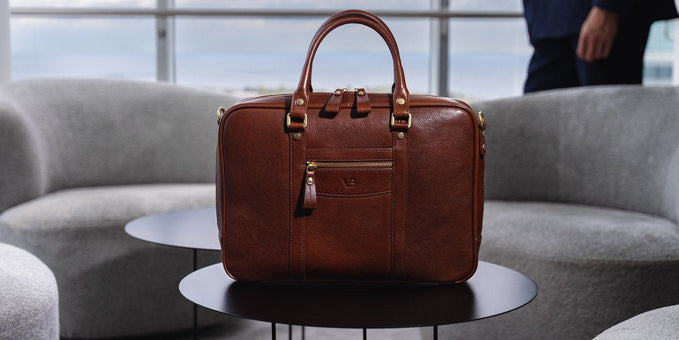
Our briefcases carry no logo plate, no metal nameplate, no printed brand name on the leather. The only marking is a discreet VB icon debossed on the inside. These are quiet brand markers, not public branding, and that understated finish is exactly what a courtroom expects.
Which one lasts: how leather and nylon age over a career
Full-grain leather lasts a career and still looks distinguished after decades of daily use. Performance nylon resists scuffs and tears well, but it frays and fades over the years rather than aging with any grace.
That said, quality beats the material label. A well-made nylon briefcase will comfortably outlast a cheap "genuine leather" one that cracks and peels within a couple of years. The grade and construction matter more than whether the tag says leather or nylon.
Leather does need some care in return. Condition it two or three times a year, wipe it clean with a damp cloth, and keep it out of prolonged wet and direct heat. It's low effort, but it isn't zero (nylon, by contrast, needs almost nothing).
How we select and build our leather
We build every briefcase in our range from full-grain leather, the highest grade, and we select A-grade hides from Bos Taurus cattle only, chosen for tight, fine, consistent grain. Our leather is cut from the bend, the back and butt of the hide, where the fibers are densest and tightest. It holds its condition through years of daily use, staying distinguished where lower-quality leather ends up looking shabby.
We cut our bag leather to 1.4 to 1.8 mm, the thickness that lets a briefcase drape properly, hold its shape without bulking up, and stay comfortable to carry all day. The handles aren't thin because of it; they're built from multiple layers of the same leather with supporting material underneath, rather than from the thick, stiff leather that saddlery and workwear use.
Why the grade of leather decides how it lasts
Full-grain and top-grain leather keep the strong outer surface of the hide intact, and that is where the durability comes from. Corrected, bonded, and "genuine leather" grades have been sanded, split, or glued together from scraps, and they crack and peel because the strongest part of the hide has been removed.
The buyer's test is straightforward. Full-grain leather uses the complete outer surface of the hide with the natural grain preserved in full. It is the strongest, most durable grade. Three things to check:
- Hide grade: A-grade hides exclude excessive bites, scars, and surface damage. That selection costs more, and it's why the grain looks clean and even across the whole briefcase.
- Cut: leather from the bend (the back and butt of the hide) has the densest, tightest fibers. Belly and shoulder leather is weaker and more stretch-prone.
- Dyeing: drum-dyed leather carries color all the way through the hide rather than sitting on the surface. Look at the cut edge: if the color goes all the way through, it's drum-dyed. Surface-dyed leather fades pale at every scuff.
A certificate matters too. We put our Italian-tanned leather through Cuoio Superiore certification (meaning "superior leather" in Italian), because self-declared leather grades carry no enforceable standard. Each leather batch is laboratory-tested, and the tannery itself is audited on-site at least every three years. Every briefcase in our range carries that certification, and the documentation is included with the bag.
If you'd like to browse our full-grain leather briefcase range, click here.
Carrying a laptop and files every day

Nylon is lighter and typically offers more built-in pockets and padded tech compartments. Leather is heavier but naturally rigid: it holds its shape, protects documents from bending, and keeps a laptop secure without relying on internal stiffeners.
Your daily load is specific: a 15 or 16 inch laptop, a redweld or a stack of case files, legal pads, and whatever else the day demands. That load needs structure more than lightness, because papers and screens that flex inside a soft bag arrive creased or worse.
The weight gap is smaller than it sounds. A structured leather briefcase weighs roughly 1.1 to 1.8 kg, and at that range the difference between leather and nylon stops being the deciding factor. You notice it walking to the courthouse with a full load, but not enough to change the choice on its own. We've broken down how much each material adds in weight separately.
What does matter, regardless of material, is a secure, fully enclosed closure. If you're carrying confidential client files, your briefcase needs to close completely, and a locking option is worth having.
How our briefcases carry the load
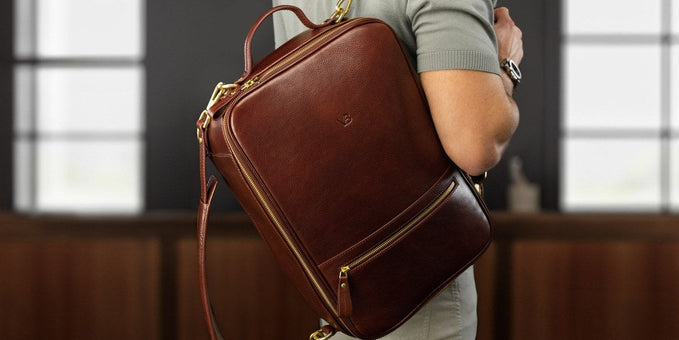
Our briefcases use a triple-gusset design with spacious compartments, and the central compartment is padded and designed to accommodate a 16-inch laptop. The No.1 Briefcase has key-lock closure and the most internal organization in the range.
We have sold over 5,000 locked briefcases in the last ten years, with under 0.1% recorded lock failures. The rare failure typically comes from dangerously excessive loads rather than normal use. The detachable crossbody strap leaves your hands free when you're moving between firm office, client site, and courtroom.
The bag's rigidity comes from leather board, a dense material made from genuine leather fiber, rather than the pressed cardboard or plastic sheets that warp or crack in cheaper construction.
Wet weather and travel days

Nylon repels water better than leather and protects your electronics and papers more reliably in bad weather. If your commute involves a long walk from the station, a bike ride, or regular exposure to rain, nylon is the more practical choice.
Leather is water-resistant, not waterproof. Conditioned and treated, it handles light rain and wipes dry without lasting damage. But a heavy soaking can leave water spots or, over time, contribute to cracking if the leather isn't dried and reconditioned properly. You wouldn't leave a leather briefcase on a wet courthouse bench.
For frequent flyers, nylon has a second advantage: weight. A lighter briefcase on a weekly flight to depositions or client sites makes a genuine difference over a year of travel, and nylon resists scuffs from overhead bins and luggage belts better than leather.
How our briefcases handle wet weather and travel
Every Von Baer briefcase is sized to meet most airline personal-item requirements and has a trolley sleeve, so your laptop and confidential papers stay with you rather than ever going into checked luggage. If you fly regularly, you can browse our travel briefcases.
If you carry leather in a wet climate, conditioning it regularly is non-negotiable. Treat it, and it handles most weather. Neglect it for years, and even the finest leather will show it.
Price and what each case costs over a career
Nylon briefcases cost less to buy. A quality leather briefcase is a significantly larger investment upfront, but if it lasts a career, the cost per year can end up lower than replacing a nylon briefcase every few years.
The real waste isn't spending more on leather. It's spending on a cheap "genuine leather" briefcase that cracks within two years, because then you've paid a leather price for nylon durability without nylon's advantages.
Price comes down to grade, hardware, and construction more than the word on the label. A full-grain leather briefcase with high-grade hardware and reinforced stress points will outlast one that cuts corners on any of those, regardless of what the branding says.
How we price and back our briefcases
We design every Von Baer briefcase for that working week, not for a photoshoot. Every product is built for years of use and covered by our 5-year warranty.
If a bag was built wrong somewhere, that flaw exists from day one and usually shows up within the first year or two of normal use. The honest warranty in this industry runs one to two years. We cover five, more than double, because the warranty covers the defects and the construction covers the lifetime.
We sell direct-to-consumer, allowing us to use superior materials while maintaining honest, consistent pricing. Never on sale. Never overpriced.
The verdict: which briefcase to buy for your practice

For most lawyers, a structured full-grain leather briefcase in a dark color is the right choice. It looks right in court, holds up across a career, carries a laptop and files securely, and looks more distinguished the longer you use it.
What to look for:
- Full-grain leather (not corrected, bonded, or "genuine")
- A structured body that holds its shape on a desk or beside a chair
- A padded laptop compartment with separate space for documents
- Understated hardware in a dark color, no visible branding
- A secure closure, ideally with a locking option for confidential files
Pick nylon instead if:
- You commute by transit or bike and your briefcase gets rained on regularly
- You fly weekly for depositions or client sites and need the lightest briefcase
- You haul heavy electronics every day and weight is the priority
- Your firm has a modern, tech-forward culture where formality isn't expected
- You're at the start of your career and need a solid briefcase on a tight budget (a quality nylon one is a better buy than a cheap leather one)
Some lawyers split the difference with a nylon-body briefcase that has leather trim at the handles and closure. It's a genuine category, and for certain working lives it makes sense.
If you're buying for someone else (a law graduate, a new partner, a spouse entering their own practice), the same logic applies. Full-grain leather is the safer gift because it lasts long enough to become part of their daily identity. Add blind-embossed initials and the briefcase carries a discreet personal signature.
The leather briefcase range is built for this working life: full-grain leather from A-grade hides, with every model covered by our 5-year warranty. Our personalization is hand-applied with heated brass type at no extra charge, so what's visible on the leather tag is their name, not ours. If you're looking for the specific models, our cases for legal work are where to start.
For the step-by-step walkthrough, the full selection process goes deeper. We also cover the full material breakdown beyond leather and nylon in a separate guide.
FAQs

Are leather briefcases waterproof?
No. Leather briefcases are water-resistant, not waterproof. They handle light rain and resist water better when the leather is conditioned regularly. But heavy soaking can leave water spots or cause damage over time, so protect your briefcase from sustained rain and snow. If you need reliable weather protection for electronics and documents, nylon repels water more effectively.
How do I care for a leather briefcase?
Condition it two or three times a year, wipe it clean with a damp cloth, and let it dry naturally away from direct heat. Store it stuffed with paper or cloth to hold its shape when you're not using it. The effort is low: a few minutes every few months.
How much does a good lawyer's briefcase cost?
A quality leather briefcase is a premium purchase. The price comes down to the leather grade, the hardware, and the construction more than the brand name, so look for specifics: full-grain leather with a checkable grade, high-grade hardware, and reinforced stress points. Good nylon costs less upfront. The check on any premium leather claim is whether the grade is certified and the documentation is in the box with your briefcase.
What is the best type of bag for lawyers to take to court?
A structured briefcase that stands on its own, holds files and a laptop, and comes in a dark, understated color. Leather is the traditional courtroom choice because it carries the formality expected there. An attache case works equally well if you prefer the harder shell. Avoid anything with visible branding, bright colors, or a shape that looks casual. If those are the criteria, we'd recommend the Von Baer Diplomat Briefcase or the Von Baer No.1 Briefcase. Both are structured, dark, and understated, and the No.1 Briefcase has key-lock closure for confidential case files.

Author: Igor Monte
Igor Monte is the co-founder of Von Baer. He's an expert in all things premium leather, from being an end-user right up to the design and manufacturing process. His inside knowledge will help you choose the best leather product for you.
We strive for the highest editorial standards, and to only publish accurate information on our website.
Related Articles



Leave a Comment
Your email address will not be published.