Which Bags Are Perfect for a Weekend Getaway?

Most people buy the wrong weekend bag because they start with style or brand instead of how they actually pack.
If you want a bag that works for years, use a simple system:
- Step 1: Identify what you actually pack
- Step 2: Choose the correct bag type
- Step 3: Match the right capacity
- Step 4: Check critical design features
- Step 5: Choose durable materials
This prevents the most common mistake: buying a bag that looks good but is frustrating to travel with.
Step 1: Define What You Actually Pack

Image: Weekender Bag
The shape and density of your gear matters more than the number of items.
A weekend trip for work packs very differently from a casual getaway.
| Trip Type | Typical Gear | What the Bag Needs |
|---|---|---|
| Business trip | Laptop, chargers, wrinkle-sensitive clothes | Structured interior and tech compartments |
| City break | Casual clothing, light jacket, sneakers | Flexible compartments and quick access |
| Activity weekend | Workout gear, outdoor equipment | Durable lining and separation for gear |
Rule: The more structured your items are (laptops, shoes, dress clothes), the more structured your bag should be.
Traveling for business? We compare the best bags here.
Typical Packing List for a 48–72 Hour Trip
This is the loadout most professionals actually carry:
- 2–3 shirts
- 1 spare pair of pants or outfit
- 1 lightweight jacket or sweater
- 1 pair of shoes
- Compact toiletry kit
- Laptop or tablet
- Chargers and accessories
Packed efficiently, this fits comfortably inside a 30–35L travel bag.
Pro tip: Rolling clothes or using packing cubes reduces clothing volume by roughly 20–35%.
Step 2: Choose the Right Type of Weekend Travel Bag

Image: Grand Leather Garment Bag
Different bags solve different travel problems. Choose the category that matches how you move.
Weekender Bags (Structured Holdalls)
Best for professionals who want a versatile bag for short trips.
- Typical capacity: 30–40L
- Shape: Rectangular for efficient packing
- Access: Wide zip opening
Why this works: rectangular bags keep clothing stacked neatly and prevent wasted space.
Want to buy? Browse all luxury weekenders here.
Travel Duffel Bags
Duffels prioritize flexible storage.
- Large single compartment
- Minimal internal structure
- Flexible fabric construction
Best for: gym-heavy or casual trips with bulky clothing.
Trade-off: items pile up quickly, making small accessories hard to find.
(Wondering if this size works for flights? See whether a duffel bag counts as a personal item.)
Travel Backpacks

Image: 10X Laptop Travel Bag
Backpacks maximize mobility.
- Padded shoulder straps
- Laptop compartments
- Typical capacity: 25–35L
Advantage: distributing weight across both shoulders reduces perceived weight by roughly 30–40%.
They work well when you expect long walks or heavy transit use.
Compact Carry-On Suitcases
Rolling luggage protects clothing and fragile items.
- Hard or semi-rigid shells
- Internal compression systems
- Strict airline sizing
Trade-off: wheels struggle on stairs, cobblestones, and crowded sidewalks.
Step 3: Choose the Correct Bag Size

Image: Voyager Carry-On Bag
Oversized bags cause more problems than small ones.
Extra space encourages overpacking.
Ideal Capacity for Weekend Trips
| Trip Length | Recommended Capacity |
|---|---|
| 1–2 nights | 25–30L |
| 2–3 nights | 32–40L |
Sweet spot: most frequent travelers settle around 32–36 liters.
Airline Carry-On Size Limits
Most airlines allow bags up to:
22 × 14 × 9 inches (56 × 36 × 23 cm)
Soft travel bags usually perform best when they are slightly smaller.
Practical guideline: choose bags around 20–21 inches long to avoid overhead bin issues.
If airline sizing confuses you, see our guide comparing carry-on vs personal item bags.
Why Bag Shape Matters
Capacity numbers are misleading if the shape wastes space.
Look for bags with:
- Rectangular footprint for stacked packing
- Flat reinforced base so the bag stands upright
- Wide clamshell opening for visibility
A well-designed 35L rectangular bag often holds more usable gear than a poorly shaped 45L duffel.
Step 4: Look for Features That Reduce Travel Friction

Image: Voyager Carry-On Bag
Small design details determine whether a bag is easy or annoying to use.
Interior Organization
- Laptop sleeve for 14–16 inch devices
- Internal zip pockets for chargers
- Mesh compartments for accessories
- Exterior quick-access pocket for passport or phone
Goal: every category of item has a fixed place.
Shoe Storage
Shoes take significant volume inside travel bags.
A good shoe compartment should include:
- 10–12 cm compartment height
- Water-resistant lining
- Ventilation for odor control
This also works for damp workout clothing.
Wide-Opening Packing Design
Clamshell openings allow full visibility when packing.
Benefits include:
- Faster packing
- Easier use with packing cubes
- Better organization in small hotel rooms
Step 5: Choose Durable Materials

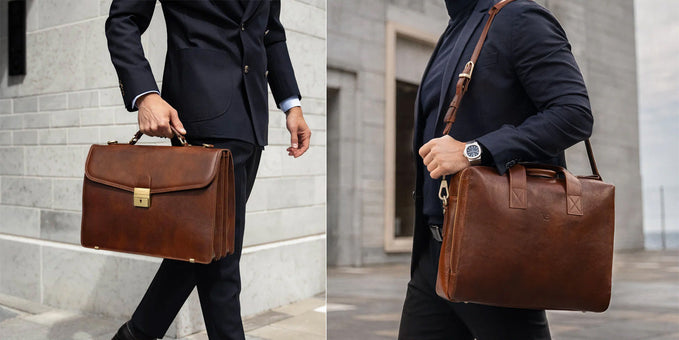
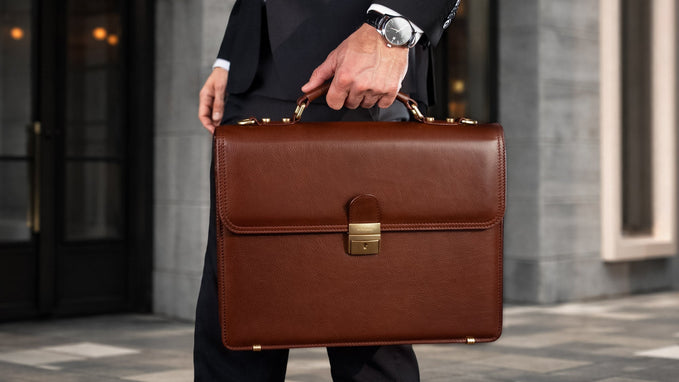
Image: Elegant Briefcase
Material quality determines how a bag ages.
Leather Travel Bags
- Full-grain or top-grain leather
- Natural abrasion resistance
- Develops patina with use
High-quality leather bags often last decades when paired with metal hardware.
(Maintenance tips: see how to maintain leather bags.)
Canvas and Ballistic Nylon
- Waxed canvas: water-resistant and durable
- Ballistic nylon (840D–1680D): extremely abrasion resistant
Denier (D) measures fiber thickness. Higher numbers generally indicate tougher fabric.
Construction Details That Matter
- Reinforced stitching at handles and strap anchors
- Heavy-duty metal zippers
- Thick interior lining
- Reinforced base panel
Build quality usually matters more than material alone.
Comfort and Mobility Features

Image: Weekender Bag
Your bag will spend a lot of time on your shoulder during travel.
Look for:
- Padded adjustable shoulder strap
- Reinforced carry handles
- Balanced strap anchor placement
- Trolley sleeve for attaching to rolling luggage
- Empty weight under 3–3.5 lbs (1.4–1.6 kg)
Professional Appearance
Weekend bags appear in semi-professional environments like airports and hotel lobbies.
Choose understated designs:
- Structured silhouette
- Neutral colors (black, navy, dark brown)
- Minimal external branding
If you travel frequently for professional work, our lawyer's travel guide covers additional travel gear considerations.
FAQs
How big should a weekend travel bag be?
Most people need 30-40 liters for a 2–3 day trip.
Can a weekend bag count as a carry-on?
Yes, if it fits within airline limits (usually 22 × 14 × 9 inches).
Is a backpack or duffel better for weekend travel?
Backpacks are better for mobility. Duffels work well for gym-style packing with bulky clothing.
Should a weekend bag have structure?
Structured bags protect clothing and maintain organization better than very soft bags.

Author: Albert Varkki
Albert Varkki is the co-founder of Von Baer. He understands leather products as a consumer, supplier, and a manufacturer, helping you with the inside knowledge you need, to choose the perfect leather product for you.
We strive for the highest editorial standards, and to only publish accurate information on our website.
Related Articles




Leave a Comment
Your email address will not be published.