Still Juggling a Bulky, Overstuffed Wallet? Here’s Why You’re Constantly Frustrated (Even If You Don’t Realize It)

Quick question: what’s the one thing you touch every day, but haven’t thought critically about since high school?
Yep - your wallet.
Let’s be honest, most of us are walking around with little leather filing cabinets that haven’t evolved since our first job interview. It’s fat, disorganized, and full of emotional baggage - receipts from places you don’t remember, a punch card from that coffee shop you ghosted, and that random gift card with $1.42 on it… just in case. It’s a brick in your pocket, and you’re lugging it around like some medieval satchel.
You’re not alone. Most men carry a wallet that’s working against them.
Why does it matter? Because every time you reach into that overstuffed lump at a bar, or during a business lunch, or at TSA, you’re wasting seconds and giving off unintentional signals. Signals that say unprepared, disorganized, still clinging to that Blockbuster membership. You might look sharp otherwise - but that awkward shuffle through a thick leather flap full of clutter? It dulls the edge.
A client told me he didn’t realize how much better life could feel until his new slim wallet let him walk into a meeting without that awkward wallet outline distorting the line of his tailored pants. He’d just invested in a made-to-measure suit, and that chunky old trifold was wrecking the entire silhouette. That switch made him rethink his everyday carry like a domino effect - keys, phone, even how he folded cash.
A traditional bifold wallet often measures 4.5” x 3.5” x 0.75” when filled, while a slim wallet optimized for efficiency typically lands closer to 4” x 2.8” x 0.3”. That’s a 60% reduction in bulk - literally removing a visual bulge from your life.
Ever notice how people like Ryan Reynolds or Daniel Craig always look like they’ve got nothing in their pockets? It’s not magic - it’s discipline. And the wallet is step one.
Quick summary of what to buy:
- The leather should always be, to ensure it keeps its refined lookall Von Baer wallets use A-grade full-grain leather - the top selection grade, chosen for tight, fine, consistent grain - see them here).
- It should have RFID-blocking technology to protect your card data.
- It should be practical to use, and the right size for your outfit (which may mean you need multiple wallets).
Takeaway: The wrong wallet doesn’t just take up space - it eats confidence and leaves a mark - literally and metaphorically.
If the old way of carrying isn’t working, what’s the smarter design solution?
Looking for Function Without Bulk? Slim Wallets Aren’t All the Same - Here's What Actually Matters

Minimalism looks sexy online. But try using some of those viral cardholders in real life, and you’ll realize they’re basically Instagram props with the ergonomics of a paperclip. Great in theory. Painfully slow in a real checkout line.
You’ve seen those guys - the ones at Whole Foods holding up the line while they pick cards out like they’re shuffling Uno. That’s what happens when you prioritize “slim” without factoring in real usability.
Here’s the fix:
-
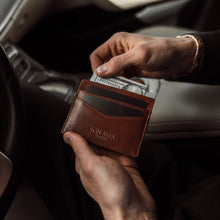
Quick-access slots: You should be able to grab your go-to card in one motion. Think thumb-slide, not origami.
-
Pull-tabs: Great for hiding cards you use less frequently - like that Costco membership you only need on weekends. Bonus: no card bending.
-
Staggered layouts: Avoid the “card brick” effect by choosing wallets that offset stack height. Like layering thin pancakes, not stacking bagels.
Materials? Now we’re getting into personality. If you want that rich, lived-in character, full-grain leather is your move - cut to 1.0-1.2 mm for a wallet, smells like an upscale boot shop, and keeps its refined look for years. It’s the leather equivalent of a good bourbon: smooth and made to last. Bonded leather? Think boxed wine by comparison - synthetic, shiny, cheap.
Looking to buy? Browse these minimalist slim wallets.
Real-world example: I personally rotated through five minimalist wallets before landing on one that had a full-grain leather shell with an ergonomic layout. Before that? I’d been that guy doing a half-pocket-dig at the subway turnstile while holding up the entire line. The difference? I could now flash my MetroCard with one motion - no fold, no flap, no fumble. In a New York rush hour, that feels like gaining superpowers.
Pro tip: Test your wallet one-handed. If you can’t grab your card while holding a coffee in the other hand, the wallet’s working against you.
We have a full guide on wallet sizes here.
Takeaway: It’s not about being thin - it’s about being thoughtfully engineered. The goal isn’t minimalism for its own sake. It’s flow.
You’ve got the function. Now, how do you make sure it fits the vibe?
Why a Wallet Can Silently Undercut Your Style (And How the Right One Fixes That Instantly)

Imagine James Bond pulling out a camo nylon trifold with Velcro. Doesn’t compute, right?
Your wallet is part of your outfit - even when it’s invisible. The moment it appears, it needs to cohere with everything else: your coat, your shoes, your watch, your voice. It’s like background music at a great bar - you only notice it when it’s wrong.
So ask yourself:
-
If your wardrobe leans into streetwear - think Off-White, Carhartt, Nike - go rugged. Waxed canvas, raw-edge leather, maybe something modular.
-
Into techwear or monochrome minimalism? Matte metals, magnetic closures, no visible branding. Think Steve Jobs meets Monocle.
-
Wearing sport coats and clean denim? Go full-grain leather with refined stitching. Quiet luxury. Like something Esquire would casually include in their “Things We Like” list.
Fact: Anything thicker than 0.5” in your pocket ruins the line of slim pants. Fashion rule, not opinion.
Styling tip: Treat your wallet like a leather accessory. Would you wear a bright red belt with brown brogues? Same logic.
Takeaway: Don’t think of your wallet as an accessory. Think of it as the punctuation mark on your personal style sentence.
Matching your look is one thing - but what if you’re buying for someone else?
Gifting a Wallet? Here’s How to Avoid Giving One That Feels Thoughtless

We’ve all been there. You’re at a birthday or graduation, hand someone a box, and they smile politely - then never use it. Why? Because the gift had no context.
A wallet, if done right, is intimate. It says, “I see how you move through the world.” But give the wrong one, and it feels like a hotel keycard holder with a price tag.
Ask first: How do they pay?
-
Digital-first guys (Apple Pay, tap cards): Go for an RFID-blocking minimalist - max 6-card capacity, no cash sleeve.
-
Cash-carriers: Bifold or hybrid wallet with note slot, ideally with a divider for receipts (bonus points if it has a zippered coin pouch).
-
Travelers: Get serious - look at full travel wallets like the Von Baer Harrington, which fits two passports, SIM card storage, and has dual-currency sleeves.
Packaging matters too. You want the opening experience to feel like Mr Porter curated it - not like you grabbed it at a gas station. Think magnetic box, soft cloth wrap, and a clean, foil-stamped logo - like a Montblanc pen box but for your EDC.
Gifting tip: Avoid personalization on the front - keep initials subtle and discreet on the inside corner.
Takeaway: A great wallet gift doesn’t scream. It whispers: “I pay attention.”
Even with the best intent, most wallets wear out. But why do some last and others crumble?
What Makes a Wallet Last Beyond a Year (And Why Most Start Failing Sooner)
Let’s get forensic.
Wallets live in brutal conditions: back pockets, high humidity, temperature swings, friction from denim, sweat, dirt, oils, pressure. It’s like a CrossFit course for leather.
Here’s what matters:
-
Edge finishing: Look for wallets with edges burnished and sealed with beeswax or acrylic resin. It prevents fraying. If the edge looks fuzzy or ragged, skip it.
-
Stitch density: Ideal range? 7–9 stitches per inch (SPI). Anything more is overkill (can weaken leather); anything less is prone to splitting.
-
Thread type: Linen or polyester thread coated with wax lasts longest. Avoid cotton - it soaks moisture and degrades.
-
Interior: Natural lining (like pigskin or twill) holds up under pressure. Synthetic linings peel faster than old wallpaper.
Real-world example: A friend once bought a luxury-brand wallet - coated leather, flashy logo, big price. Within months, the edges bubbled. Turns out it was PU-coated split leather - basically a fancy sticker on bad material. The brand offered 10% off a replacement.
Test tip: Press your thumb into the leather and look for a subtle color shift - it should darken under pressure, then return. That’s full-grain. If it looks flat and plastic? Skip it.
Takeaway: Durability is a sign of care - not just in how the wallet was made, but in the values of the brand who made it.
If the craftsmanship checks out, let’s talk about when and where this wallet earns its keep.
Your Wallet Gets More Screen Time Than You Think - Make Sure It’s Worth Showing
We all have that moment: the card pull at dinner, the flash at the hotel check-in, the slide at a client lunch. Your wallet enters the spotlight - even if just for 3 seconds.
That’s a performance. Tiny, but telling.
-
At a rooftop bar, it says: I’ve got my life in order.
-
At an airport lounge, it says: I travel well.
-
On a date, it says: I care about the details.
It’s the equivalent of your phone’s lock screen, or your email signature - compact, personal, and full of information.
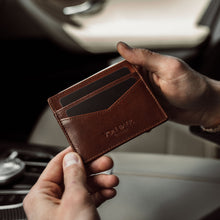
Real-world example: A friend pulled out his leather cardholder at dinner and placed it on the table while checking the bill. Someone asked, “Where’s that from?” - not because it was expensive, but because it looked intentionally chosen. No logo. Just structure, finish, and restraint.
Test tip: Place your wallet on a white napkin at dinner. If it still looks sharp under restaurant lighting - clean seams, elegant form - you’ve nailed it.
Takeaway: Choose gear that lives up to scrutiny - not because you expect compliments, but because you're ready when they come.
Should I invest in a luxury wallet?
Many people opt to buy luxury wallets because of their excellent durability and craftsmanship.
One of the downsides of doing this is obviously the high initial expense.
If you do decide to buy this kind of wallet, make sure you’re opting for one that comes with a certification of authenticity that has high ratings and is in a style that appeals to you.
See the definition of a wallet here.
We also posted about wallet history, and about types (link).











Your email address will not be published.